
 Norsk Bokmål
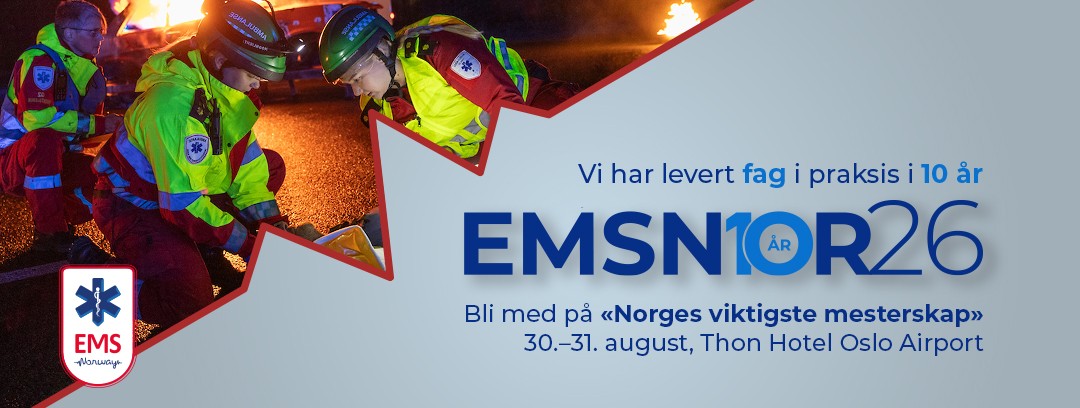
EMSNOR26 – National Ambulance Championship 2026
Registration for the anniversary championship is open
Registration for EMSNOR26 is now open. Ambulance personnel from across Norway, and for the first time international teams as well, will gather for what is regarded as Scandinavia’s leading professional competition for operational prehospital personnel. EMSNOR26 brings together professional pride, realistic scenarios, and a valuable meeting place for knowledge sharing and exchange of experience among prehospital personnel from across the country.
Intense scenarios
Realistic and demanding assignments that test teamwork, clinical judgement, and procedural knowledge under pressure.
Top-class learning outcomes
All participants receive structured feedback from experienced professional judges. Take valuable knowledge back to everyday practice.
Professional community
Meet colleagues from across the country. Build networks and share experience across regions and health trusts.
Completed
Thank you all!
EMSNOR26 took place on 30 and 31 August 2026 at Thon Hotel Oslo Airport, with 13 teams through 13 scenarios, and international teams on the start line for the first time. Registration is closed.
Next year brings the regional championships again. Stay tuned for information!
International class
1. Center of Disaster Medicine, Ukraine
2. Den Præhospitale Virksomhed, Denmark
National class
1. Helse Stavanger HF, Ambulansetjenesten
2. Oslo University Hospital, Ambulance Department North
3. St. Olavs hospital
Every team receives its own feedback from the judges, together with statistics from the assessment system.
Questions about the championship? Contact us at post@emsnorway.no.
Behind the scenes
Would you like to contribute next time?
The championship depends on dedicated professionals behind the scenes. We need people for several roles.
Judge
Professionally strong people who evaluate participants and provide high-level feedback.
Observer
Representatives from management, clinical departments, supervisors, or colleagues can follow the teams throughout the competition.
About EMSNOR26
Norway’s toughest prehospital showdown
In 2026, EMS Norway marks 10 years of clinical practice in action. We are celebrating with a championship that combines competition, learning, and community at the highest level. EMSNOR26 takes place in parallel with Ambulanseforum and brings the professional community together for two intense days of exciting scenarios, professional development, and experience sharing.
EMSNOR 2026, also known as the National Ambulance Championship, has earned its reputation as Norway’s most important championship for good reason. It is the most important practice-oriented competence and professional meeting place for operational personnel.
It provides valuable experience, learning, and unity across health trusts, regions, and countries. It is exciting, fun, and educational.
This is not just something you take part in. It is something you carry forward in your career, and an experience you will remember and look back on with good memories.
What awaits you?
Realistic assignments
Realistic and demanding assignments that test clinical judgement, teamwork, and procedures under pressure.
Professional growth and structured learning
All teams are assessed through a standardized and transparent evaluation system with clear criteria, weighting, and achievement targets.
Evaluation system
- Objective assessment based on defined criteria
- Clear weighting in the judging forms
- Focus on achievement of objectives in each scenario
Learning points and statistics
As a participant:
- Concrete learning points after completed cases
- Insight into your own performance measured against the criteria
- Access to evaluation and statistics afterwards
This gives you a solid foundation for professional development, even after the championship is over.
- Concrete learning points after completed cases
- Insight into your own performance measured against the criteria
- Access to evaluation and statistics afterwards
Strong community
An arena that combines competition, learning, and community at the highest level, where you build networks while meeting colleagues from across the country.
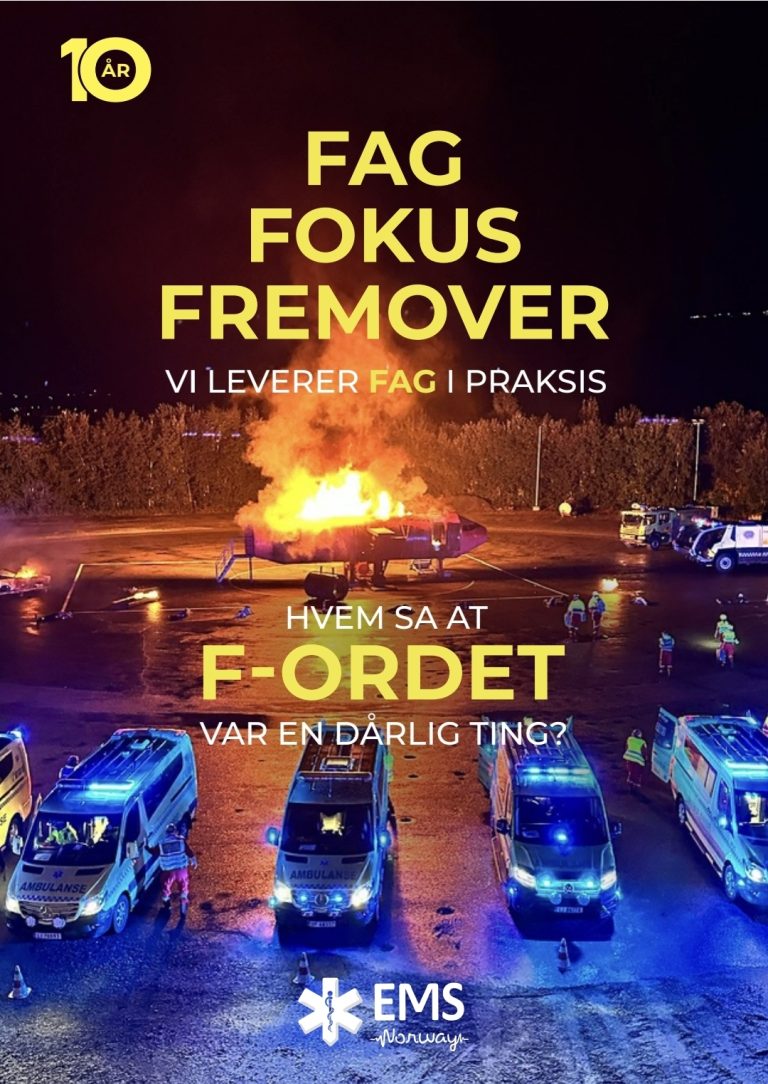
10 years
An anniversary for clinical practice in action
EMS Norway has delivered clinical practice in action since 2016. EMSNOR26 marks an entire era and the beginning of the next decade.
At last, it is time for a new round of the National Ambulance Championship. Some teams are already qualified through local competitions in their region, but several open places remain.
Who can participate?
For participating teams
Prehospital personnel affiliated with a Norwegian health trust may participate, and a team consists of three people with a competence level equivalent to approved staffing of an emergency ambulance.
We recommend that all teams provide at least one additional person who can serve as a judge during the competition. It is also recommended to have a reserve participant available in case of illness.
All registered teams must have financial coverage for participation.
Note: To participate, you must be a member of EMS Norway. As a member, you are covered by our event insurance in the event of accident/injury while participating. This is mandatory for everyone.
Not already a member? CLICK HERE
Student teams
Separate class for students/apprentices
Dedicated student teams from paramedicine programs, minimum third-year students (or second-year students who have completed a practice placement), may also register.
Apprentices are also welcome to enter their own team.
Student and apprentice teams compete in a separate class, but complete the same case scenarios.
International teams
Teams from other countries will participate in a separate class, but complete the same case scenarios.
International teams are welcome. Use the team registration link above, and contact EMS Norway if you need clarification about travel, class placement, or practical requirements.
Team format (all classes)
- Exactly 3 people per team
- Everyone must be registered before submission
- One additional person per team who can serve as a competition judge
- A reserve solution in case of illness is recommended
- All registrations must have financial coverage
Championship rules
Rules for judging
The Ambulance Championship shall be conducted with objective and fair judging, clear criteria, and a high professional and ethical standard.
Aim and purpose
- Promote emergency medical skills.
- Ensure objective and fair judging for all participants.
Participation
- Only qualified personnel may participate.
- Qualification criteria must be clearly defined during registration.
- Only paying members of EMS Norway may participate.
Jury and judges
An independent main jury and an experience-based judging group with high professional competence in prehospital emergency medicine will be established.
Main jury at the National Ambulance Championship
- An independent jury with at least three members with high professional competence in prehospital emergency medicine will be established.
- Geographical and organizational diversity should be sought to ensure an impartial and unbiased jury.
- The jury is led by a jury chair. In the event of dissent during the handling of a formal complaint from a participating team, the jury chair has the casting vote.
Judges
- An independent and experience-based group of judges will be established.
- Diversity in the group must be ensured to avoid bias, with as equal representation as possible from relevant stations, health trusts, or regions.
- The judges must have high professional competence within their field.
- Each participating team is assessed by two judges. In cases with multiple patients, the number of judges is increased by one additional judge per patient.
Transparent criteria
Clear and transparent criteria shall be defined for judging participants’ performances. The criteria shall show how the cases are weighted between medical interventions, operational assessments, teamwork, care, and critical interventions.
- Medical interventions, operational assessments, teamwork, care, and critical interventions account for 95%.
- The judge may give a subjective assessment, which accounts for 5%.
- The criteria are published after the championship.
Scoring system
The assessment criteria are described for each individual case. For each assessment criterion, the team can achieve:
- 0 points: not performed
- 1 point: partially or incompletely performed
- 2 points: performed
The predefined weighting affects the value of achieved points in each individual case. The scoring system must allow assessment of medical and operational skills, teamwork, care for patients, relatives, and others, as well as critical interventions.
A relative score is calculated so that the cases have equal significance in the overall assessment.
Realistic competition
- Participants are judged on their ability to manage realistic emergency situations.
- The scenarios may be varied and challenging, and must reflect real working conditions.
- Participants must not be exposed to unnecessary psychological trauma.
Team complaint procedure
The goal is for the competition to be fair, and for all teams to have equal terms and conditions during case completion. Participating teams may complain about the judging or completion of a case scenario during a championship.
Complaints may only concern formal errors for which the team itself is not responsible. Professional assessment of the team’s performance cannot be appealed.
Formal errors may, for example, include incorrect information, late information, too little time during the response, inappropriate disruption of the work at or before a station, or other circumstances that may have given the team poorer conditions than other teams.
A complaint must be made orally at the end of the case, and then in writing, electronically or on paper, to the organizer’s representatives through judges or staff immediately and as soon as possible after the challenged station has ended.
Complaints are handled by an appointed jury consisting of three chief judges. The complaint is processed and decided before results are published. The main jury’s decision is final and cannot be appealed.
If the complaint is upheld, the team may be allowed to complete the case again, or points may be deducted or added.
Training, ethics, and integrity
- The organizer is responsible for ensuring that judges receive the necessary training to understand and apply the assessment criteria.
- The competition shall be conducted with a high ethical standard among judges and participants.
- Emphasis is placed on honesty, openness, accountability, and respect.
- EMS Norway’s ethical guidelines apply to the conduct of ambulance championships.
Ethical guidelines
For participants in ambulance championships
Participants shall act with respect, professionalism, safety, and integrity throughout the event.
Respect for simulated patients and judges
Participants must always follow instructions and directions from judges or the case lead on site. If real simulated patients are used, participants must not cut clothing or perforate skin, for example by establishing IV access or measuring blood glucose, without explicit consent.
Quality and clinical guidelines
Participants shall strive to provide the best possible treatment and care for all patients by following the current guidelines used as the basis for the competition.
Safety
Participants must follow the HSE plan and/or instructions given by case leads, and ensure the safety of themselves, colleagues, and simulated patients during the competition.
Honesty and integrity
Participants must always act honestly and with integrity during the event, and must not perform actions that could damage trust in the profession as a whole.
Professional collaboration
Participants shall demonstrate good collaboration with other healthcare personnel, emergency services, and volunteers during the competition.
Reflection and learning
Participants shall be open to reflecting on their own actions and performance, and use the experience for learning as practitioners.
Fair play
Participants shall treat fellow competitors with respect and sportsmanship, and avoid any form of unfair competition practice.
Practical information
Everything you need to know
Date
30-31 August 2026
Two competition days
Location
Thon Hotel Oslo Airport
Gardermoen – easy access by plane and train
Payment
Invoice
EHF supported. Requires coverage from employer.
EMS Norway membership
Mandatory
Required for insurance – applies to all roles
Not a member? Join here
For judges and observers
Individual registration with separate options for additional resources and observation.
Preliminary program
Two days of professional development, scenarios, and community
The program is preliminary and will be updated continuously leading up to the championship.
Sunday 30 August
| Time | Event | Location |
|---|---|---|
| 12:00 – 14:00 | Arrival and registration | Thon Hotel Oslo Airport |
| 14:00 | Judge/participant briefing | Thon Hotel Oslo Airport |
| 15:00 | Joint procession | Thon Hotel Oslo Airport |
| 15:15 | Convoy departs | Thon Hotel Oslo Airport |
| 15:30 | Arrival at the town hall square | Ullensaker Town Hall |
| 15:40 | Team and group photos | Blue Light Day, town hall square |
| 16:30 – 17:30 | Opening ceremony | Ullensaker Town Hall |
| 18:30 | Dinner | Thon Hotel Oslo Airport |
| 19:30 – 22:30 | Evening shift | EMS |
Monday 31 August
| Time | Event | Location |
|---|---|---|
| 06:00 – 07:45 | Breakfast | Thon Hotel Oslo Airport |
| 08:00 | Joint departure | Thon Hotel Oslo Airport |
| 08:15 | Briefing – preparation | Ambulance Center North |
| 08:45 – 16:45 | Day shift | EMS |
| 12:00 – 13:00 | Break / Lunch | At the station |
| 17:00 | Final countdown | Meet at THOA |
| 17:30 – 20:00 | Personal time | |
| 20:00 | Celebration dinner – award ceremony | Europahall |
The program is subject to change.
Looking back
See highlights from previous championships
Realistic scenarios, a high professional level, and powerful moments have been part of the championship since the beginning.
Album 2018 part 1
Album 2018 part 2
Album 2018 part 3
Frequently asked questions
Who can participate?
Prehospital personnel affiliated with a Norwegian health trust may participate. A team consists of three people with a competence level equivalent to approved staffing of an emergency ambulance.
Can student teams participate?
Yes. Student teams from paramedicine programs, minimum third-year students, may participate in a separate class, but complete the same case scenarios.
Do we need a reserve participant?
Yes, all teams should make sure they have a reserve participant available in case of illness.
Do we have to be members of EMS Norway?
Yes. To participate, you must be a member of EMS Norway. This is mandatory because membership includes insurance during the event in case of injury/accident.
What must the team cover itself?
All registered teams must have financial coverage for participation.
When will the final program be available?
The preliminary program with times is already on the page. Any adjustments will be published continuously leading up to the championship.
How do observers and judges register?
Observers and judges use the dedicated registration link in the registration section. Feel free to contact EMS Norway if you are unsure which role is the best fit.
How are the teams judged?
Teams are judged according to defined assessment criteria for each case. The assessment includes medical interventions, operational assessments, teamwork, care, and critical interventions. The judge’s subjective assessment makes up a smaller part of the total score.
Can a team appeal the judging?
Yes, but complaints may only concern formal errors for which the team itself is not responsible. Professional assessment of the performance cannot be appealed. A complaint must be made orally at the end of the case and then in writing as soon as possible after the station has ended.
What ethical requirements apply to participants?
Participants must follow instructions from judges and case leads, maintain safety and HSE requirements, act honestly and professionally, collaborate well with others, and treat fellow competitors with respect and fair play.